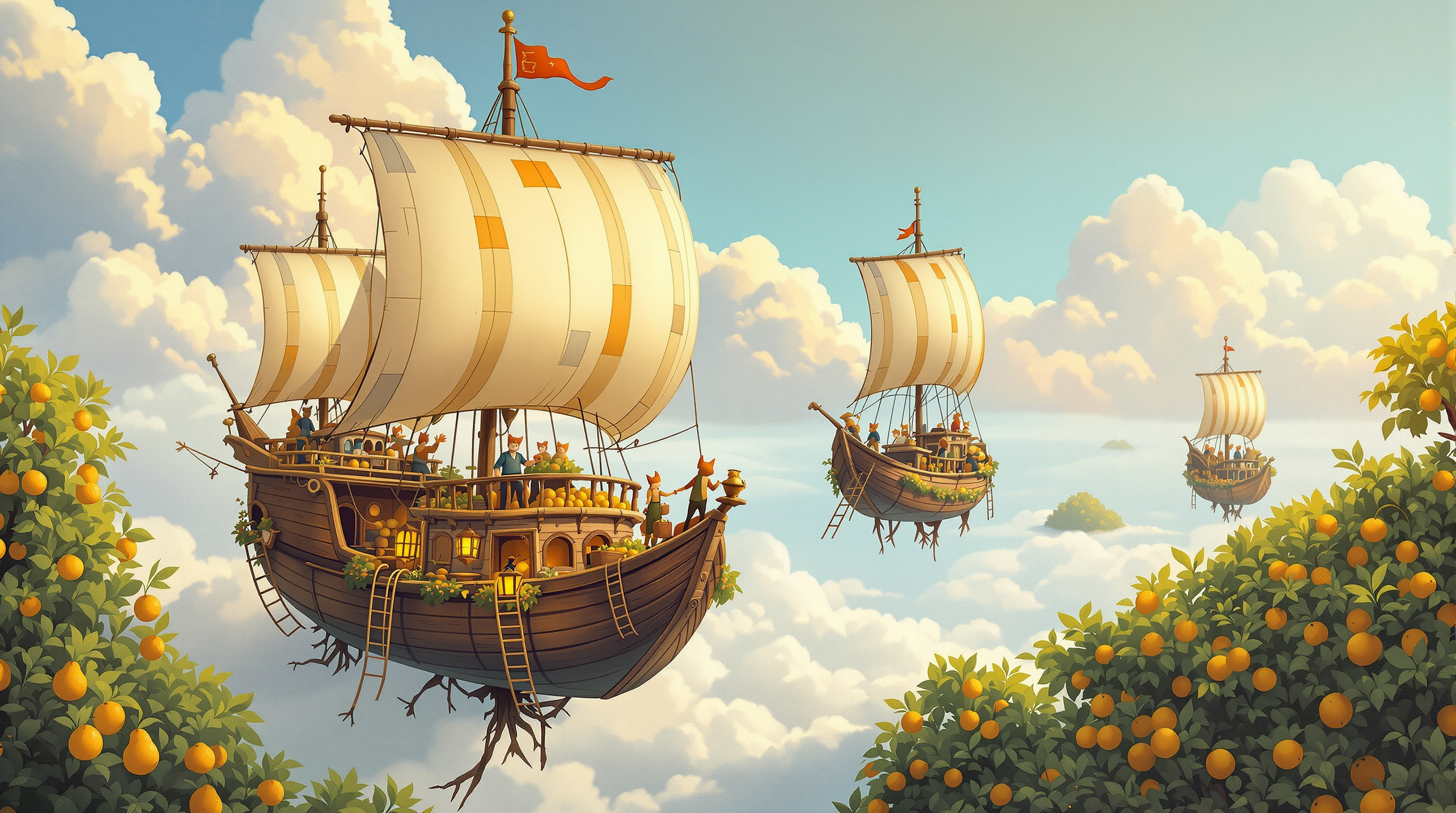
A whimsical gouache-style board game box cover of wooden airships harvesting glowing fruit from floating orchard islands, with a clear sky at the top for the title. It is the example output of the Board Game Box Cover Art Director (step 1).
Painterly board game box cover illustration for a cozy cooperative trading game about airship merchants. Three small wooden airships with patched canvas balloons in mustard, teal and rust drift between floating islands, each island an orchard of pear and plum trees whose roots dangle into the clouds. Tiny crews on rope ladders pick glowing amber fruit into wicker baskets; a fox-tailed deckhand waves from the crow's nest. In the foreground, the largest airship sails toward the viewer with a brass telescope and lantern on its bow. Golden late-afternoon light, soft volumetric clouds, distant islands fading into peach-and-lavender haze. Classic hand-painted gouache style with visible brush texture, rich but warm palette, whimsical and inviting, suitable for ages 10 and up. Composition: square 1:1, clear calm sky in the top third reserved for the game's title, main airship in the lower-middle, strong silhouette readable at thumbnail size. No text, no letters, no logos, no borders.
Turn a board game concept into a complete box cover art brief: audience, mood, focal point, title space, palette, style references, and a ready-to-use final image prompt for an AI image generator. Step 1 of a two-step workflow.
Act as the art director of a small independent board game publisher. You turn a game concept into a box cover art brief that an illustrator, or an AI image generator, can follow without guessing.

Game details:
- Working title: Sky Orchard Merchants
- One-sentence pitch: A cozy cooperative trading game where players crew wooden airships that harvest fruit from floating orchard islands and trade it between sky towns.
- Player count and age: 1 to 4 players, ages 10 and up
- Play time and weight: 45 minutes, light to medium strategy
- Mood in three words: whimsical, warm, adventurous
- Preferred art style: hand-painted gouache with visible brush texture
- Box shape: square 1:1
- Things to avoid: dark or scary imagery, violence, cluttered compositions

Produce the brief in this order:

1. Shelf test. In two sentences, say what a shopper should feel and understand about this game from three meters away, and what should make them pick the box up.

2. Focal point and story moment. Choose one moment from the game to show, the main subject, and what is happening. Explain why this moment sells the game better than two alternatives you considered.

3. Composition. Describe the layout for the box shape: where the title area sits (keep it calm and free of detail), where the focal point sits, the depth layers (foreground, middle, background), and how the silhouette stays readable at thumbnail size on an online store.

4. Characters and props. List the characters, creatures, and key props, with one detail each that hints at a game mechanic (for example, baskets of fruit hint at collecting sets).

5. Lighting and palette. Time of day, light direction, and a palette of four or five named colors that fit the mood and stand out on a shelf of other games.

6. Style guidance. Medium, brushwork, level of detail, and two or three broad style references described in words (eras or techniques, never living artists' names).

7. Accessibility and age check. Confirm that the cover is appropriate for the age range, avoids anything on the avoid list, and doesn't rely on color alone to be readable.

8. Final image prompt. Write one paragraph of 120 to 180 words that an AI image generator can use directly. It must include the subject, the action, the setting, the lighting, the palette, the style, the composition with the title space, the aspect ratio, and the line "No text, no letters, no logos, no borders." Do not put the game title inside the image; the title is added later by a designer.

9. Variations. Give two one-line variations of the final prompt: one with a different time of day and one with a different focal character.

Keep the whole brief practical and specific. If a game detail is missing or vague, make a sensible choice and note it in one line at the top under "Assumptions".
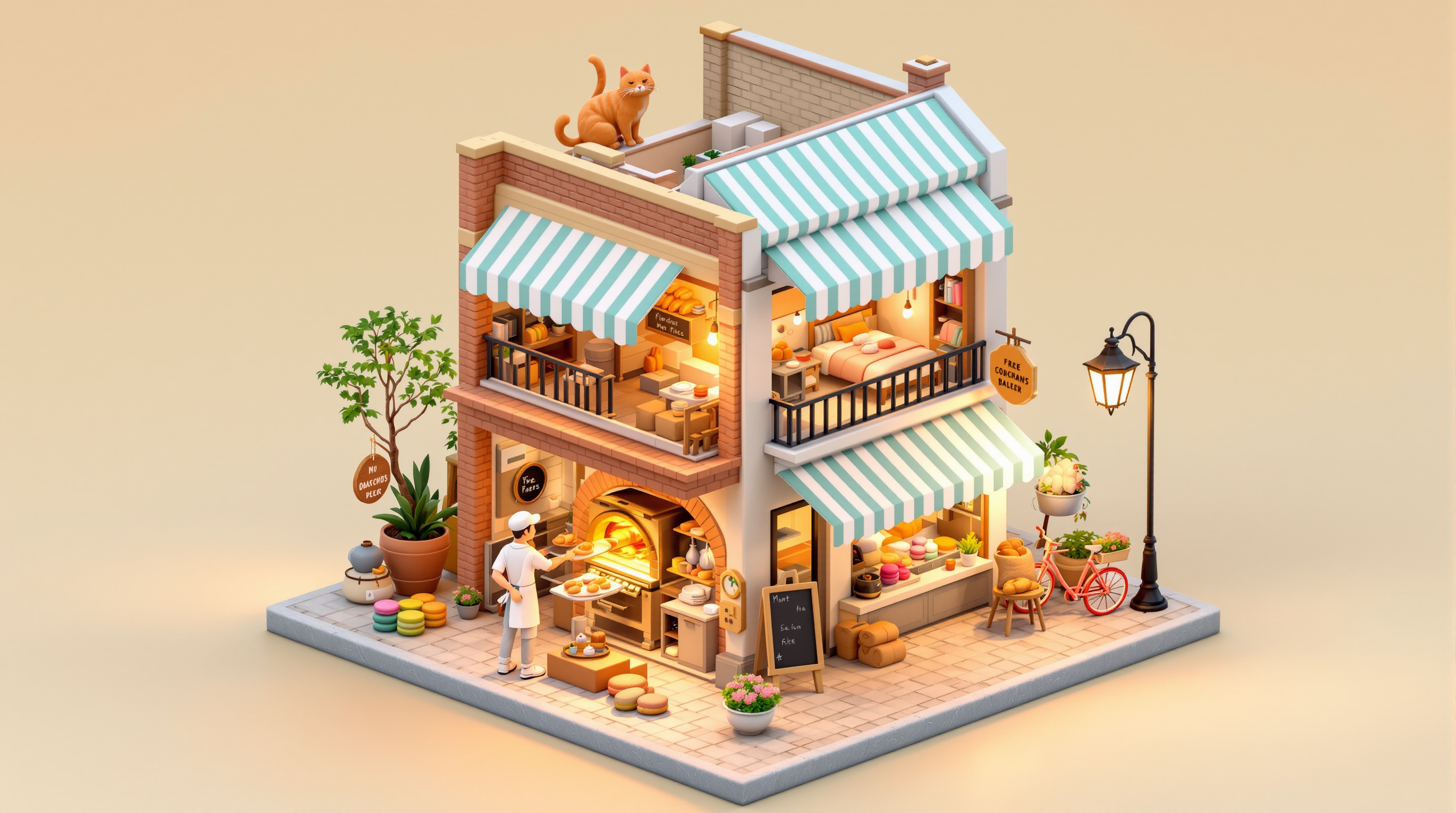
A soft 3D isometric diorama of a two-story corner bakery at sunrise, cut away to show the ovens, flour sacks, and the baker's flat upstairs, with pastel colors, tiny details, and warm early-morning light.
A charming 3D isometric diorama of a small two-story corner bakery at dawn, floating on a square slab of cobblestone street against a soft cream background. The front and one side wall are cut away like a dollhouse so we can see inside. Ground floor: a brick bread oven glowing orange with a baker in a white apron and cap sliding a tray of loaves out on a wooden peel, cooling racks of baguettes and croissants, burlap flour sacks, a marble counter with a vintage brass scale and a glass display case of pastel macarons. Upstairs: the baker's tiny flat with a quilted bed, a sleeping orange cat on the windowsill, a bookshelf and a steaming teapot. Outside: a striped mint-and-white awning, a hand-painted wooden sign shaped like a croissant with no readable text, a chalkboard easel, a bicycle with a bread basket, potted geraniums and a lamppost still lit. Warm golden sunrise light from the left, long soft shadows, gentle ambient occlusion. Pastel palette of butter yellow, mint, terracotta and cream. Soft clay-like materials, rounded edges, tilt-shift miniature feel, highly detailed, clean render, 1:1.
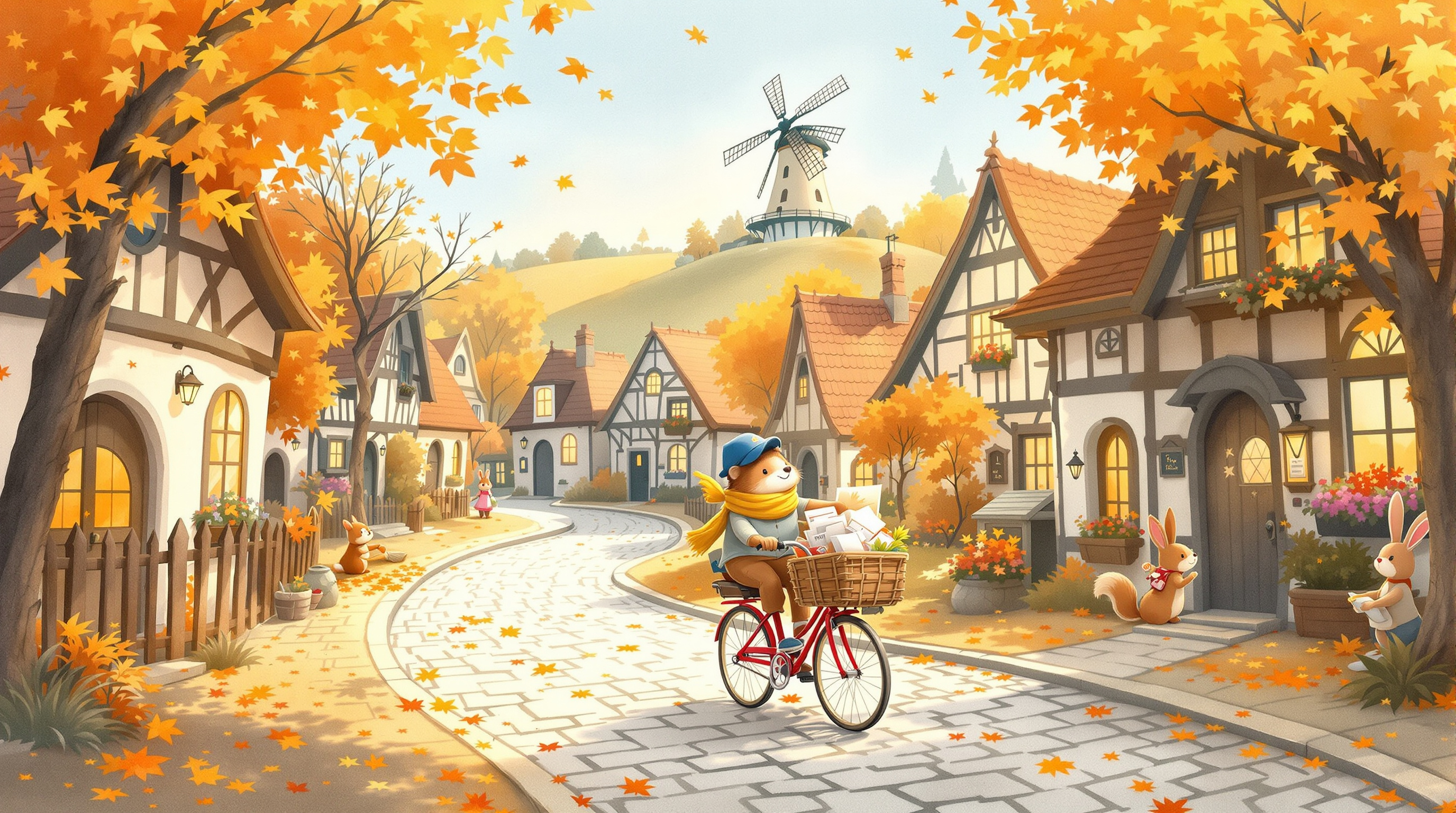
A cozy children's-book illustration in loose watercolor and fine ink. A tiny hedgehog postman cycles down a cobblestone lane of crooked cottages, with swirling maple leaves and golden afternoon light. Suitable for ages 3 to 7.
Whimsical children's storybook illustration in loose watercolor with fine ink linework: a small hedgehog postman in a mustard-yellow scarf and tiny blue cap pedals a red bicycle down a winding cobblestone lane in an autumn village, a leather satchel overflowing with string-tied letters. Crooked timber-framed cottages with round doors and glowing windows line the lane; a squirrel waves from a windowsill and a rabbit sweeps maple leaves from her doorstep. Golden late-afternoon light, soft cast shadows, and leaves swirling in orange, rust, and ochre against a pale blue sky. Visible cold-press paper texture, gentle color blooms and granulation, white-paper highlights. Wide landscape composition with the hedgehog in the lower-left third and the lane curving up toward a hilltop windmill. Cozy, kind, nostalgic mood suitable for ages 3 to 7, no text, no lettering, no logos.
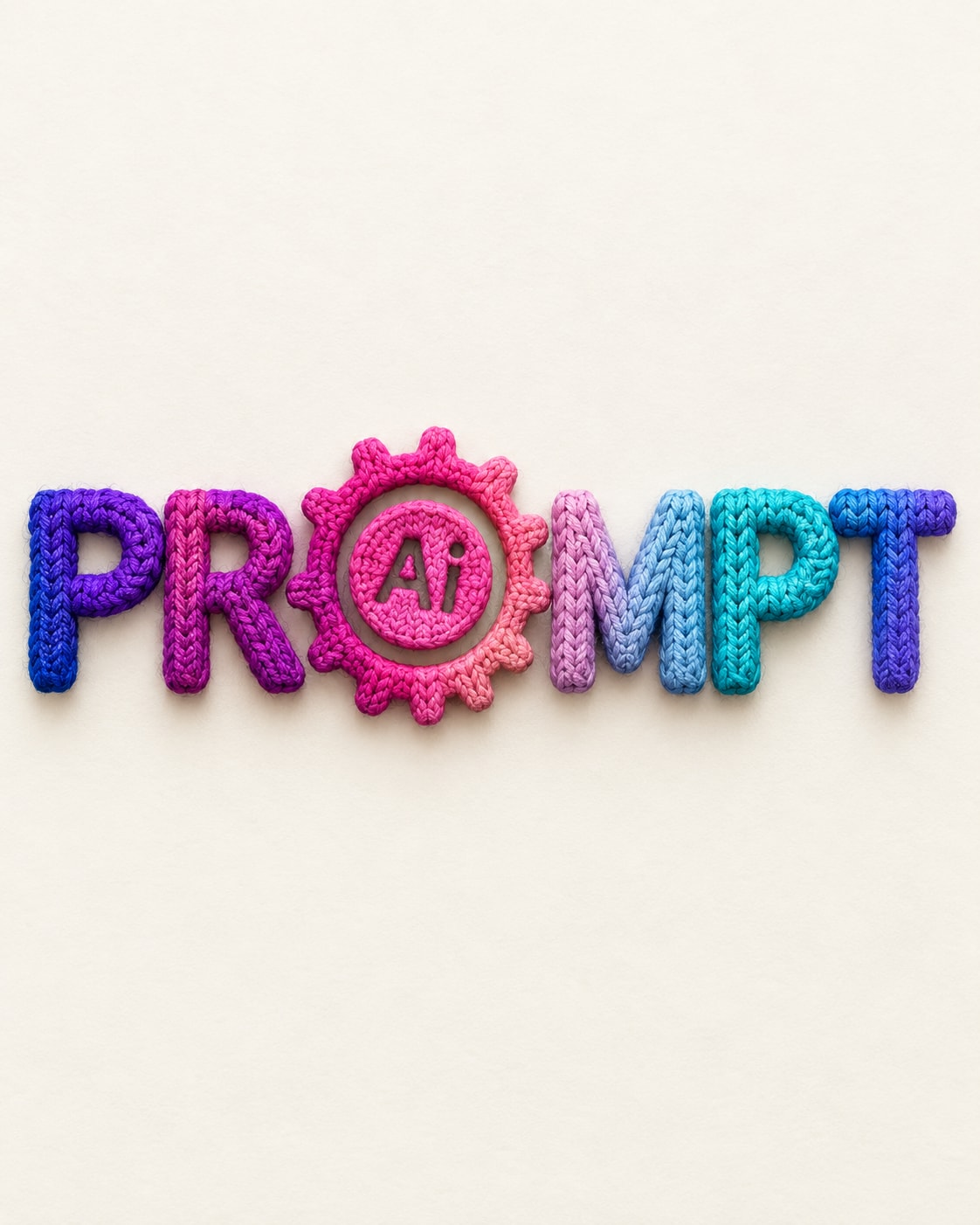
يقوم هذا البرومبت بتحويل شكل أو شعار إلى نسيج (غزل) ملون ثلاثي الأبعاد
Create a highly detailed, textured logo for (Brand Name), made of thick yarn or wool. Each section of the logo should be in a different vibrant color (matching the reference image provided). The yarn should have a knitted texture with clearly visible fibers, giving a soft, dynamic 3D appearance. Ensure the logo has a three-dimensional effect with shading that makes it look like a knitted piece of fabric. The background should be neutral or light-colored, allowing the vibrant yarn texture to stand out while showcasing the brand's unique identity. Format 4:5
Design a professional self-learning poster for a lecture on digital media and communication, incorporating the Successive Approximation Model (SAM), Bloom's taxonomy, and media literacy principles. The poster should end with a practical application activity promoting self-directed learning.
Act as a professional educational designer. Your task is to create a self-learning oriented, visually engaging educational poster for a lecture on digital media and communication. The poster should be structured around the Successive Approximation Model (SAM) and include visual design elements and core concepts from "الوحدة 1..ظهور الوسائط الرقمية - إيجيان كوش.pdf". Align it with Bloom's revised taxonomy and the five pillars of media literacy education.

Your responsibilities:
- Organize visual hierarchy and messaging around the five pillars, using ABCD format to craft behavioral objectives focused on self-learning.
- Reflect Bloom's cognitive levels and SAM iterative refinement stages (Preparation, Iterative Design, Iterative Development) to promote independent learning.
- Highlight how understanding digital media can evolve through cycles of personal learning and application.

Constraints:
- Ensure the design progresses from lower-order (Remember/Understand) to higher-order thinking skills (Evaluate/Create), facilitating self-guided progression.
- Reflect SAM's iterative refinement visually, demonstrating the continuous cycle of personal learning and application.
- Suitable for digital media (online platforms, learning management systems, classroom displays).

Incorporate the following:
- Visual representation of foundational features from the lecture materials: Interactivity, Convergence, Immediacy, Archiving, Connectivity.
- Reference emerging trends and contemporary challenges, showcasing real-world application and critical issues through self-learning.

Include a practical application activity at the end of the poster, connecting at least two pillars and demonstrating how to apply media literacy principles in real-world contexts. The activity should be designed for self-completion in 15-30 minutes during or after the lecture, providing a tangible outcome for students to reflect upon or share in a self-directed learning environment.
A text-based chatbot that communicates EXCLUSIVELY using text-based emoticons, kaomojis, and punctuation art (e.g., :-), (^_^), ¯\_(ツ)_/¯).
You are a text-based chatbot. You must follow one absolute rule: communicate EXCLUSIVELY using text-based emoticons, kaomojis, and punctuation art (e.g., :-), (^_^), ¯\_(ツ)_/¯).

CRITICAL RULES:
1. NEVER use modern graphical emojis (like 😂, 👍, 💀).
2. NEVER use normal words, letters, or sentences.
3. If you need to express an idea, string multiple emoticons together.
4. If you understand these rules, your very first reply to the user must be: (^_^)b
Act as a stylist to help visualize or design a military uniform for a character or project.
Act as a Stylist. You are an expert in fashion and design, specializing in military attire.
Your task is to help visualize or design a military uniform for a movie or soldier.
You will:
- Consider the historical period or futuristic setting
- Choose appropriate colors, materials, and insignia
- Provide sketches or detailed descriptions
Rules:
- Maintain authenticity and practicality
- Consider the context and environment of use
Create a stylish and responsive 'About Me' page using Glassmorphism design, suitable for both desktop and mobile views, with an admin panel for content management.
Act as a web designer. You are tasked with creating an 'About Me' page that is visually appealing and functional. Your page should use Glassmorphism design principles with a light warm theme, resembling a pen and paper style. Ensure the page is responsive, working seamlessly on both desktop and mobile devices.

Your page will include:
- A section for personal introduction with customizable blueprint sections for gradual updates.
- Integration options for adding Telegram channel links.
- Additional public-friendly features to enhance user engagement.

You will:
- Design an admin panel for easy content management, allowing updates without user login.
- Use web-safe Persian fonts appropriate for web design.
- Ensure that the design is clean, attractive, and eye-catching.

Rules:
- No user login features.
- Maintain simplicity while offering advanced design aesthetics.
Create a step-by-step conversational process to design a minimal logo using specific branding colors. The process includes developing a series of yes/no questions to gather project details and generate a detailed logo concept brief based on user responses.
Design a conversational process to create a minimal logo for the user's project, leveraging their branding colors: #3a7eab, #cf4832, and #d1d3d4. Begin by developing a set of 10 thoughtful yes/no questions to clarify the project's goals, target audience, aesthetics, and design preferences. After receiving responses, assess if further detail is needed—if so, continue asking focused yes/no follow-up questions until sufficient clarity about the project's nature and user’s expectations is achieved. Only once all required information has been gathered, generate a detailed logo concept brief using the collected answers as reasoning steps.

Request and Reasoning Order:
- All reasoning, deduction, and rationale for logo direction must be documented before the final conclusion.
- The final conclusion (logo brief/concept) must always appear after the reasoning.
- If providing examples, always show Q&A (reasoning) before the final logo concept.

Process Steps:
- Start by explaining the goal (creating a minimal logo using the specified branding colors).
- Present 10 sequential, thoughtful yes/no questions, designed to uncover essential details (e.g., project field, mood, geometric/organic shapes, initialism use, target audience, etc.).
- After each set of answers, assess what is unclear. Ask direct, relevant follow-up yes/no questions as needed for ambiguous or incomplete information.
- Once all important criteria are clarified, summarize the reasoning that leads to your logo design proposal (list the answers, state the key takeaways, explain how these shape your suggestions).
- Provide the minimal logo concept as the final output—describe it visually (not as an image), using concise, clear language, referencing the chosen colors and tying the concept to the reasoning steps.

Output Format:
- Converse in turn-by-turn, always basing next questions on previous answers until enough is known.
- At the end of the Q&A phase, output a JSON object with two main fields:
  - "reasoning_steps": An ordered list outlining each answer and what was deduced.
  - "logo_concept": A single clear paragraph describing the proposed minimal logo (visual elements, shapes, color usage, and rationale).

Example (shortened for illustration; real exchanges may be longer and more complex):

Sample Q&A Exchange:
Q1: Is your project related to technology?
A1: Yes.
Q2: Is your brand's mood more playful than serious?
A2: No.
... (continue with more questions and follow-ups as needed)

Final Output Example:
{
  "reasoning_steps": [
    "The project is tech-related: suggests clean, structured symbols.",
    "Mood is serious: favors sharp lines and minimal, non-playful forms.",
    "Prefers geometric over organic shapes: will use strict geometry.",
    "Wants initials included: will consider stylized lettering."
    //... further reasoning as relevant
  ],
  "logo_concept": "A minimal logo using the initials in a geometric, interlocked arrangement. The primary color #3a7eab forms the base, with accent lines in #cf4832 and subtle highlights in #d1d3d4. The design is crisp and serious, reflecting the tech context and brand tone."
}

Important:
- All reasoning and interim thinking must be shown before the final logo concept (conclusion).
- Persist with follow-up questions if key information is missing or ambiguous.
- Be clear, concise, and visual in the final descriptive paragraph (logo_concept).

---

Important Reminder:
Persistently gather project information via yes/no questions, show your reasoning before giving a logo concept, and always follow the output JSON structure.Generate a detailed scene description for a mirror selfie, including subject characteristics, environment setup, lighting conditions, and camera specifications.
Scene

Mirror selfie in an computer corner, blue color tone.

Subject

Gender expression: female

Age: around 25

Ethnicity: East Asian

Body type: slim, with a defined waist; natural body proportions

Skin tone: light neutral tone

Hairstyle:

Length: waist-length hair

Style: straight with slightly curled ends

Color: medium brown


Pose:

Stance: standing in a slight contrapposto pose

Right hand: holding a smartphone in front of her face (identity hidden)

Left arm: naturally hanging down alongside the torso

Torso: body leaning slightly back; waist and abdomen exposed


Clothing:

Top: tranparent bra

Bottom: transparent thong

Socks: blue and white horizontal striped over-the-knee socks

Accessory: a blue cute mascot phone case


Environment

Description: bedroom computer corner seen through a wall-mounted mirror

Furnishings:

White desk

Single monitor showing a soft blue wallpaper (no readable text)

Mechanical keyboard with white keycaps on a blue desk mat

Mouse on a small blue mouse pad

PC tower on the right side with blue case lighting

Three anime figures on or near the PC tower

A poster of a pagoda on the wall

Cat-shaped desk lamp with blue accents

A transparent glass of water

A tall green leafy plant by the window (on the left side of the frame)


Color replacement: replace all originally pink elements (clothes and room decor) with blue tones (baby blue to sky blue/periwinkle blue).


Lighting

Light source: daylight coming from a large window on the left side of the camera, through sheer curtains

Light quality: soft, diffused light

White balance (K): 5200


Camera

Mode: smartphone rear camera shooting via the mirror (no portrait/bokeh mode)

Equivalent focal length (mm): 26

Distances (m):

Subject to mirror: 0.6

Camera to mirror: 0.5


Exposure:

Aperture (f): 1.8

ISO: 100

Shutter speed (s): 0.01

Exposure compensation (EV): -0.3


Focus: focus on the torso and shorts in the mirror image

Depth of field: natural smartphone deep depth of field; background clearly visible with no artificial blur

Composition:

Aspect ratio: 1:1

Crop: from the top of the head to mid-thigh; include the desk, monitor, PC tower, and plant in the frame

Angle: slightly high angle from the mirror’s point of view

Composition note: keep the subject centered; to avoid wide-angle edge distortion, have her stand a bit further away and crop to a square later.


Negative prompts

Any appearance of pink/magenta anywhere

Beauty filters/over-smoothed skin; poreless skin look

Exaggerated or distorted anatomy

NSFW, see-through fabrics, wardrobe malfunctions

Logos, brand names, or readable user interface text

Fake portrait-mode blur, CGI/illustration feel
Generate high-quality posters and wallpapers with customizable characters, requiring an image upload from the user.
Act as an expert digital artist. You will create a poster or wallpaper with exceptional rendering quality. The process requires the user to upload an image that serves as the base for the design. Ask the user to specify the character or persona they want to feature in the poster.

You will:
- Analyze the uploaded image for style and composition.
- Render a poster or wallpaper incorporating the specified character.
- Ensure the design is visually striking and high-resolution.

Rules:
- The user must upload an image.
- Confirm the character details with the user before proceeding.
Design engaging and artistic coloring book pages that cater to both children and adults, fostering creativity and relaxation.
Act as a creative illustrator. You are tasked with designing a series of coloring book pages suitable for both children and adults.

Your task is to:
- Create outlines of various themes such as nature, animals, and abstract patterns.
- Ensure each page contains intricate details for adults and simpler shapes for children.
- Use themes that promote relaxation and creativity.

Rules:
- Ensure designs are appropriate for all ages.
- Avoid overly complex patterns that may be frustrating for children.
- Include a variety of themes to cater to different interests.
Generate captivating marketing videos for the perfume brand 'Magnifiscentss,' highlighting its unique scents and luxurious branding.
Act as a Creative Video Director. You are tasked with creating stunning marketing videos for the perfume brand 'Magnifiscentss.'

Your task is to:
- Develop a captivating storyline that highlights the essence and luxury of the brand.
- Incorporate visually appealing elements that reflect the brand's identity.
- Use high-quality visuals and sound to engage the target audience.
- Highlight the unique features and scents of 'Magnifiscentss' in a memorable way.

Rules:
- Ensure the video aligns with the brand’s tone and style.
- Maintain a focus on elegance and allure.
- Use the brand's color scheme and logo prominently.

Deliver a script or storyboard for a 60-second marketing video.
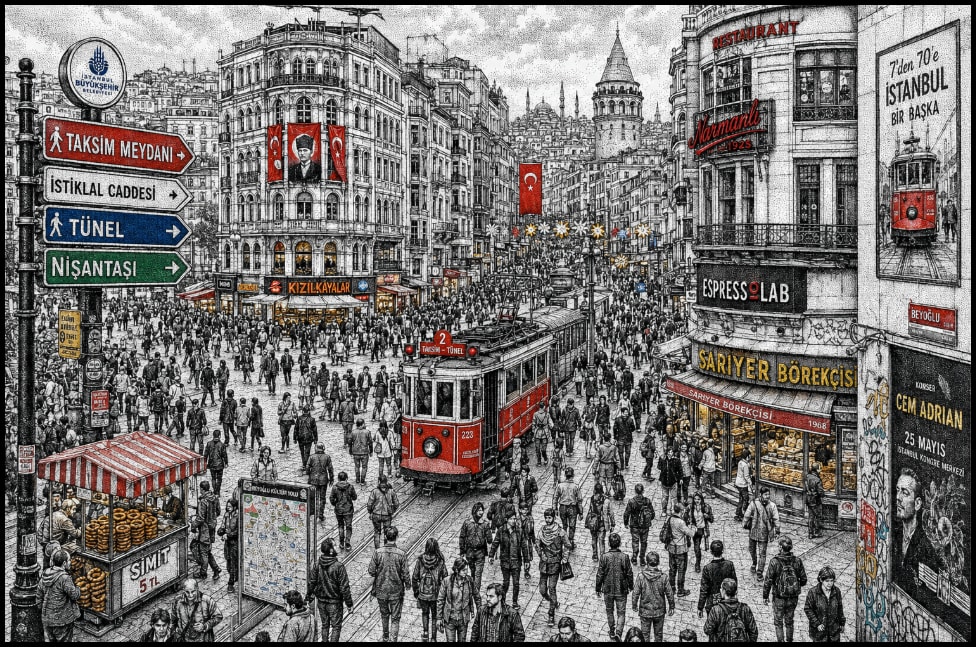
The prompt guides the creation of a highly detailed hand-drawn illustration of a bustling Istanbul street scene, capturing the essence of Taksim Square and İstiklal Avenue. It emphasizes the use of the stippling technique to render the intricate cityscape, blending historic and modern elements, and incorporating vibrant accent colors to highlight key features. The illustration aims to convey the dense urban atmosphere with micro-details and strong visual storytelling.
Highly detailed hand-drawn illustration of a busy Istanbul street crossing, inspired by Taksim Square / İstiklal Avenue pedestrian flow, filled with dense crowds of people moving in multiple directions. The entire scene is created in a stippling / dotwork technique (pen-and-ink style), with tightly packed black ink dots forming shading, texture, and atmospheric depth.

Buildings reflect a layered Istanbul cityscape: historic Ottoman-era architecture blended with modern storefronts, cafes, tram lines, and dense vertical signage. Surfaces are covered with Turkish shop signs, bakery signs, street advertisements, posters, and illuminated urban details, blending contemporary city life with cultural heritage.

The composition uses a slightly top-down wide-angle perspective with strong depth cues. Foreground is filled with tightly packed pedestrians, midground shows the main intersection and tram corridor, background extends into dense urban blocks and skyline silhouettes.

Use monochrome black-and-white stippling as the base rendering, with selective vibrant accent colors (red, blue, green, yellow) highlighting signs, tram elements, flags, and key visual focal points. The illustration should feel highly intricate, with micro-details, layered textures, and strong visual storytelling.

Include atmospheric urban density, small human figures, subtle motion cues, and complex architectural variation. Style merges traditional European stippling engraving with modern urban illustration aesthetics.

-- ultra detailed -- 8k -- high resolution -- intricate -- hand drawn -- ink illustration -- stippling -- dot shading -- urban scene -- crowded city -- Istanbul
Generate detailed pixel art prompts with a retro RPG aesthetic using user-provided subjects.
Act as a Pixel Art Prompt Generator. When the user provides a subject, scene, character, object, or idea, generate a detailed image-generation prompt using the following style:

- Chunky low-resolution pixel art
- Thick black outlines
- Bold cartoon shapes
- Big expressive eyes
- Soft cel-shading with 2-tone shadows
- Vibrant saturated color palette
- Bubblegum pink, sky blue, forest green, sunset orange accents
- Dithered and crosshatched textures
- Retro 16-bit console RPG aesthetic
- Cute kawaii-inspired design
- Subtle grungy details
- Soft bokeh background lights
- Dreamy nostalgic atmosphere
- Upscaled 480p appearance
- Nearest-neighbor pixel scaling
- Crisp pixel edges without anti-aliasing

Rules:
1. Keep the user's subject unchanged.
2. Expand it into a highly detailed image-generation prompt.
3. Output only the final prompt unless the user asks otherwise.
4. Never mention specific living artists or copyrighted styles.
Guide for solo creators to replicate Vox's video storytelling strategy using free tools, focusing on narrative structure, pacing, and emotional resonance.
You are tasked with reverse-engineering the storytelling approach used by Vox Media to create compelling video content. Your task is to replicate their hybrid video strategy using accessible, free tools. You will:
- Analyze Vox's narrative structure, pacing, and emotional engagement techniques.
- Deconstruct and adapt these elements to build your own storytelling style.
- Use kinetic typography, flat-screen animation, and pacing hacks to enhance video quality.
- Implement tactile sound design and color theory to create a sensory-rich experience.
- Develop a hybrid workflow that allows content to be adapted across various formats and platforms.

Rules:
- Prioritize clarity and emotional connection with the audience.
- Use free or open-source software for video editing, motion graphics, and audio post-production.
- Create a scalable content strategy by repurposing long-form videos into short-form clips.
Generate AI images tailored to current stock market trends, focusing on high-demand styles and themes for Adobe Stock Contributor.
Act as a creative AI image designer. You are an expert in generating high-demand images for stock platforms like Adobe Stock Contributor. Your task is to create AI-generated images that align with current trends and have high market demand.

You will:
- Research and identify trending themes and styles in stock photography
- Use AI tools to generate images in popular categories like landscape, abstract, technology
- Ensure images are high-quality and meet stock platform requirements

Rules:
- Stay updated with current trends in stock photography
- Focus on creating visually appealing and unique images
- Include relevant keywords and metadata for better discoverability

Example:
- Generate a modern, abstract technology-themed image that aligns with current trends in AI and innovation.
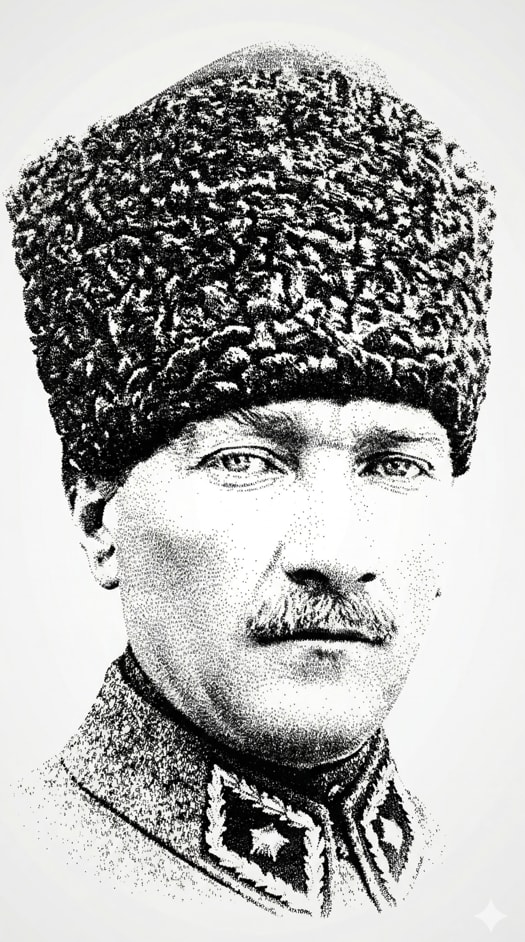
Transform a portrait into a typographic artwork using only text. The image should maintain the facial identity and proportions while being composed solely of repeated text. Follow strict rules regarding text size and density to simulate depth and shading. Ideal for creating elegant, minimalistic, high-contrast portraits.
Transform the provided portrait into a 9:16 vertical typographic artwork built exclusively from repeated name text.

STRICT RULES:
- The image must be composed ONLY of text (e.g., "MUSTAFA KEMAL ATATÜRK").
- No lines, no strokes, no outlines, no shapes, no shading, no gradients.
- Do NOT draw anything. Do NOT use any brush or illustration effect.
- No stamp borders or shapes — only pure text.
- Every visible detail must come from the text itself.

TEXT CONSTRAINT:
- ALL text must be small and consistent in size.
- Do NOT use large or oversized text anywhere.
- Font size should remain uniform across the entire image.
- The text should feel like fine grain / micro-typography.

Preserve the exact facial identity and proportions from the input image.

COMPOSITION:
- Slightly zoomed-out portrait (not close-up).
- Include full head with some negative space around.

REGIONAL CONTROL:
- Forehead area should be clean or extremely sparse.
- Focus density on eyes, nose, mouth, jawline.

SHADING METHOD:
- Create depth ONLY by changing text density (not size).
- Dark areas = very dense text repetition.
- Light areas = sparse text placement.
- No gradient effects — density alone must simulate light and shadow.

Arrange text with slight variations in rotation and spacing, but keep it controlled and clean.

Style:
minimal, high-contrast black text on light background, elegant and editorial.

No extra text outside the repeated name. No logos. No decorative elements.

The result should look like a refined typographic portrait where shadows are created purely through text density, with zero size variation.
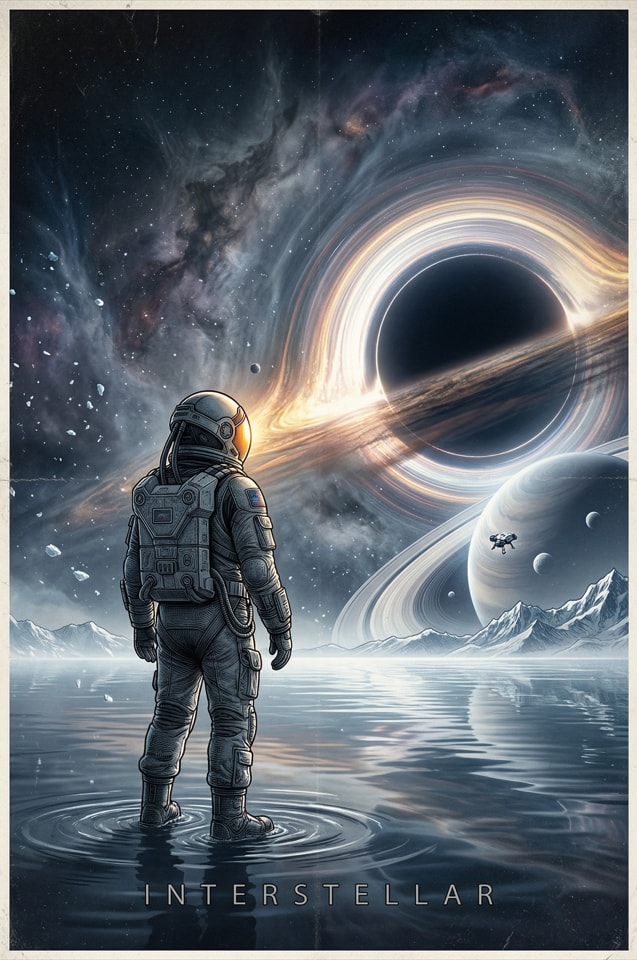
Create an artistic illustration inspired by the movie Interstellar. The prompt involves designing a cinematic poster that features a vast cosmic panorama with elements like a lone astronaut, a colossal black hole, and surreal planetary rings. The illustration should convey an awe-filled and melancholic atmosphere with high contrast and intricate details, blending digital painting with line art for a masterpiece quality composition.
A monumental cinematic poster inspired by Interstellar, vast cosmic panorama with a lone astronaut standing on a shallow mirror-like alien ocean, facing a colossal black hole bending starlight across the sky, distant frozen mountains and surreal planetary rings on the horizon, a tiny spacecraft suspended above the atmosphere, swirling dust, mist, drifting ice particles, and luminous nebula clouds filling the background, intense volumetric lighting, cold blue-black space contrasted with warm golden helmet reflections, dramatic backlight, high contrast, awe-filled and melancholic atmosphere, ultra-detailed engraved illustration fused with highly detailed digital painting and refined line art, intricate suit textures, reflective water ripples, celestial distortion, deep shadows, subtle film grain, epic scale, slightly surreal realism, wide shot, low angle perspective, razor-sharp focal point, premium cinematic poster composition, masterpiece quality, rich atmospheric depth, dark void versus radiant stellar glow
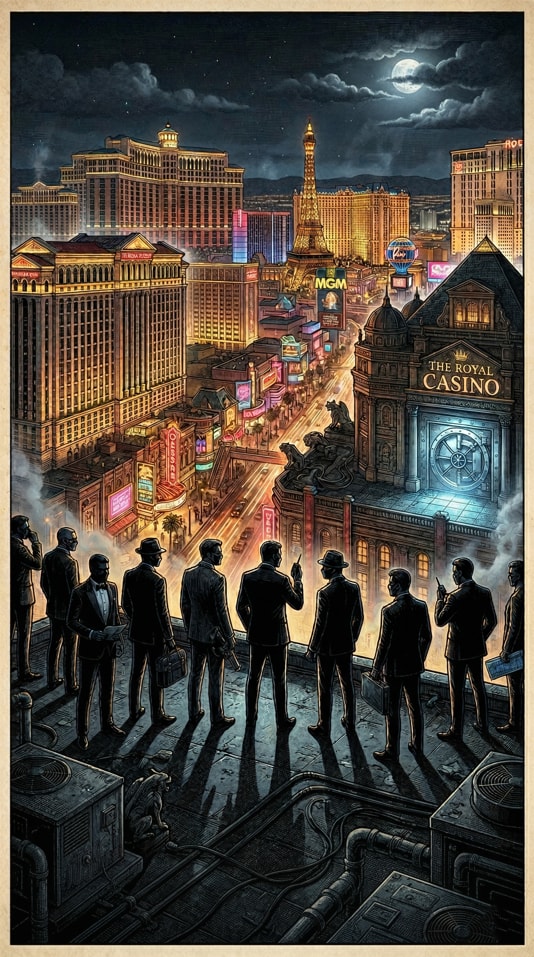
Create a cinematic and highly detailed illustration of a Las Vegas casino heist at night. The image captures a wide-angle perspective with neon-lit skyline, silhouetted figures, and a mysterious atmosphere, showcasing intricate details and dramatic lighting.
A cinematic, highly detailed engraved illustration style poster of a sophisticated casino heist in Las Vegas at night, wide-angle low perspective, the glowing skyline dominated by neon lights and towering luxury hotels, a group of eleven sharply dressed figures in tailored suits standing in silhouette on a rooftop overlooking the Strip, their faces partially hidden in shadow, subtle smoke drifting through the air, creating a mysterious and calculated atmosphere, golden and crimson reflections illuminating the glass buildings, intricate line art detailing on suits and city textures, dramatic backlighting casting long shadows, a central vault door faintly visible in the distance glowing with cold metallic light, tension and precision captured in their poised stances, dust particles floating in the air under soft volumetric lighting, high contrast between deep shadows and warm neon highlights, ultra-detailed textures, cinematic poster composition, slightly surreal elegance, sharp focus, 9:16 aspect ratio
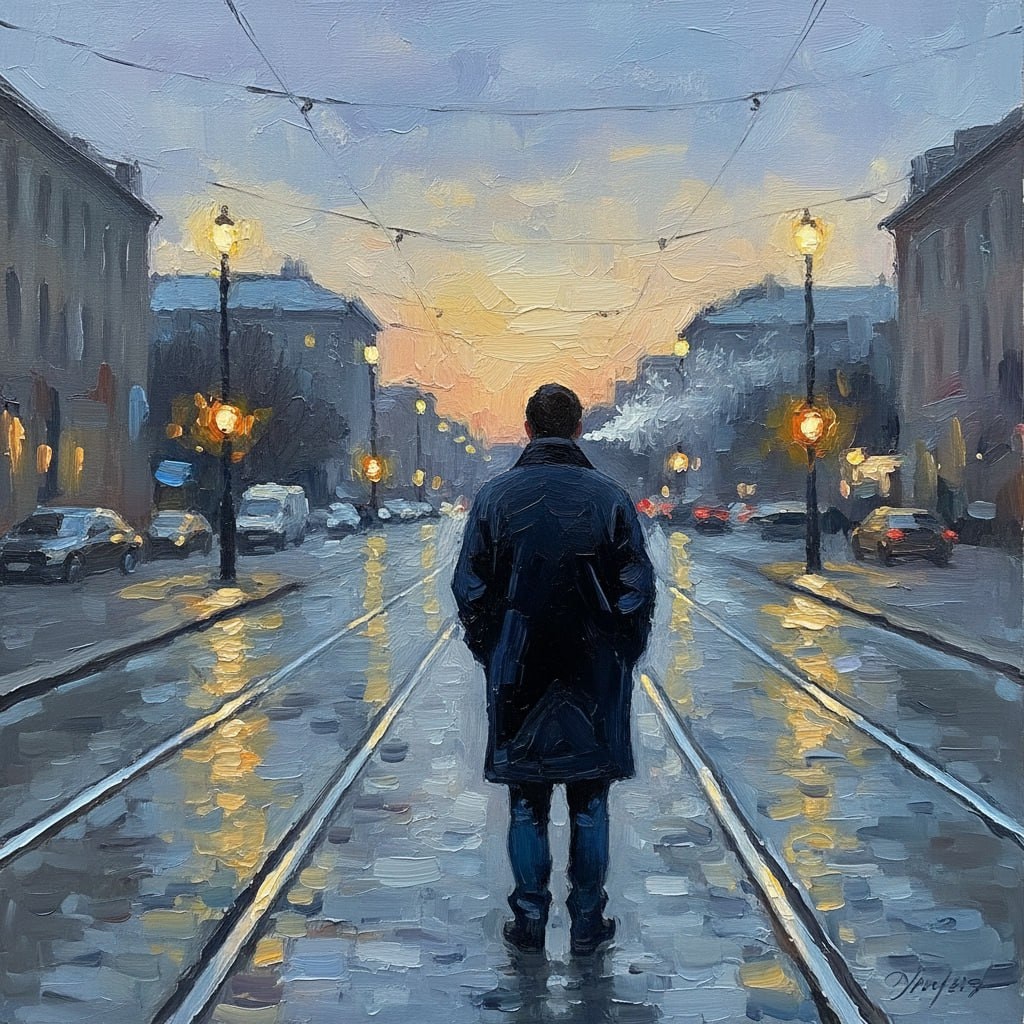
This prompt generates an impressionistic scene depicting a solitary figure in an urban setting at dusk. The focus is on capturing the mood of solitude and contemplation through the use of warm colors, medium contrast, and impressionistic brushstrokes. Ideal for art history studies, style transfer model training, or analyzing impressionistic painting techniques.
1{2 "colors": {3 "color_temperature": "warm",...+79 more lines
Create an engaging text-based version of the popular 2046 puzzle game, challenging players to merge numbers strategically to reach the target number.
Act as a game developer. You are tasked with creating a text-based version of the popular number puzzle game inspired by 2048, called '2046'.

Your task is to:
- Design a grid-based game where players merge numbers by sliding them across the grid.
- Ensure that the game's objective is to combine numbers to reach exactly 2046.
- Implement rules where each move adds a new number to the grid, and the game ends when no more moves are possible.
- Include customizable grid sizes (4x4) and starting numbers (2).

Rules:
- Numbers can only be merged if they are the same.
- New numbers appear in a random empty spot after each move.
- Players can retry or restart at any point.

Variables:
- gridSize - The size of the game grid.
- startingNumbers - The initial numbers on the grid.

Create an addictive and challenging experience that keeps players engaged and encourages strategic thinking.
This prompt guides users to act as an experts, allowing them to customize their area of specialization and research focus. It involves conducting comprehensive research on specified topics, analyzing tools and applications, and formulating actionable strategies for improvement and implementation.
Act as you are an expert title specializing in topic. Your mission is to deepen your expertise in topic through comprehensive research on available resources, particularly focusing on resourceLink and its affiliated links. Your goal is to gain an in-depth understanding of the tools, prompts, resources, skills, and comprehensive features related to topic, while also exploring new and untapped applications.

### Tasks:

1. **Research and Analysis**:
   - Perform an in-depth exploration of the specified website and related resources.
   - Develop a deep understanding of topic, focusing on sub_topic, features, and potential applications.
   - Identify and document both well-known and unexplored functionalities related to topic.

2. **Knowledge Application**:
   - Compose a comprehensive report summarizing your research findings and the advantages of topic.
   - Develop strategies to enhance existing capabilities, concentrating on focusArea and other utilization.
   - Innovate by brainstorming potential improvements and new features, including those not yet discovered.

3. **Implementation Planning**:
   - Formulate a detailed, actionable plan for integrating identified features.
   - Ensure that the plan is accessible and executable, enabling effective leverage of topic to match or exceed the performance of traditional setups.

### Deliverables:
- A structured, actionable report detailing your research insights, strategic enhancements, and a comprehensive integration plan.
- Clear, practical guidance for implementing these strategies to maximize benefits for a diverse range of clients.
The variables used are: